
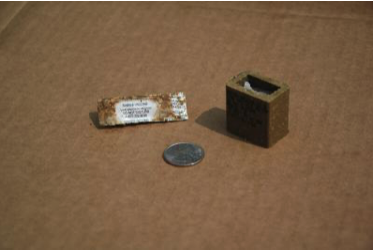
Submitted photo. In this photo of RABORAL V-RG baits, coated sachet packets (left) are used for airplane and helicopter baiting, while fishmeal polymer baits (right) used for ground/vehicle baiting.
DALTON, Ga. – The U.S. Department of Agriculture, Animal and Plant Health Inspection Service, Wildlife Services, working cooperatively with the Georgia Department of Health, will begin distributing oral rabies vaccine (ORV) baits for wildlife in parts of north Georgia during October. The smell of the ORV baits attracts targeted wild animals, such as raccoons, who eat the baits and are then vaccinated against rabies.
The ORV bait distribution program is part of management activities to prevent the westward movement of the rabies virus most often spread by raccoons. ORV baits are distributed in Georgia using airplanes and helicopters. The vaccine baits have been proven safe in many species of animals, including domestic dogs and cats. Humans and pets cannot get rabies from contact with the baits, but are asked to leave them undisturbed should they encounter them. If contact with baits occurs, immediately rinse the contact area with warm water and soap. For photos of the vaccination baits, please visit this Photo Gallery.
Helicopter baiting occurred from Oct. 3-10 and encompass the urban and suburban communities of Dalton, Tunnel Hill, LaFayette, Fort Oglethorpe, Chickamauga, Rock Spring and Ringgold. The fixed wing project is based out Dalton, Ga., and will take place from approximately Oct. 11-15, covering rural areas in Catoosa, Chattooga, Cherokee, Dade, Fannin, Gilmer, Gordon, Murray, Pickens, Rabun, Towns, Union, Walker and Whitfield counties in north Georgia, as well as areas in southeast Tennessee, northeast Alabama, and western North Carolina. Almost 1 million baits will be distributed during the program, including over 500,000 baits in Georgia alone.
Rabies is caused by a virus that infects the central nervous system in mammals and represents a serious public health concern. If exposures to the virus are not treated it is almost always fatal. Costs associated with detection, prevention and control of rabies exceed $600 million annually in the United States. According to the Centers for Disease Control and Prevention, about 90 percent of reported rabies cases in the United States are in wildlife. People are urged not to make contact with or feed wildlife and to keep their pets’ rabies vaccinations current.
ORV baits have been distributed in Georgia since 2003 as part of a larger effort by the Wildlife Services, National Rabies Management Program to prevent the westward spread of raccoon rabies by creating a barrier along the Appalachian Mountains from the Canadian border to Alabama.
For more information about the National Rabies Management Program, visit www.aphis.usda.gov/aphis/ourfocus/wildlifedamage/programs/nrmp.