
By Ron Hill
Special to The Clayton Tribune
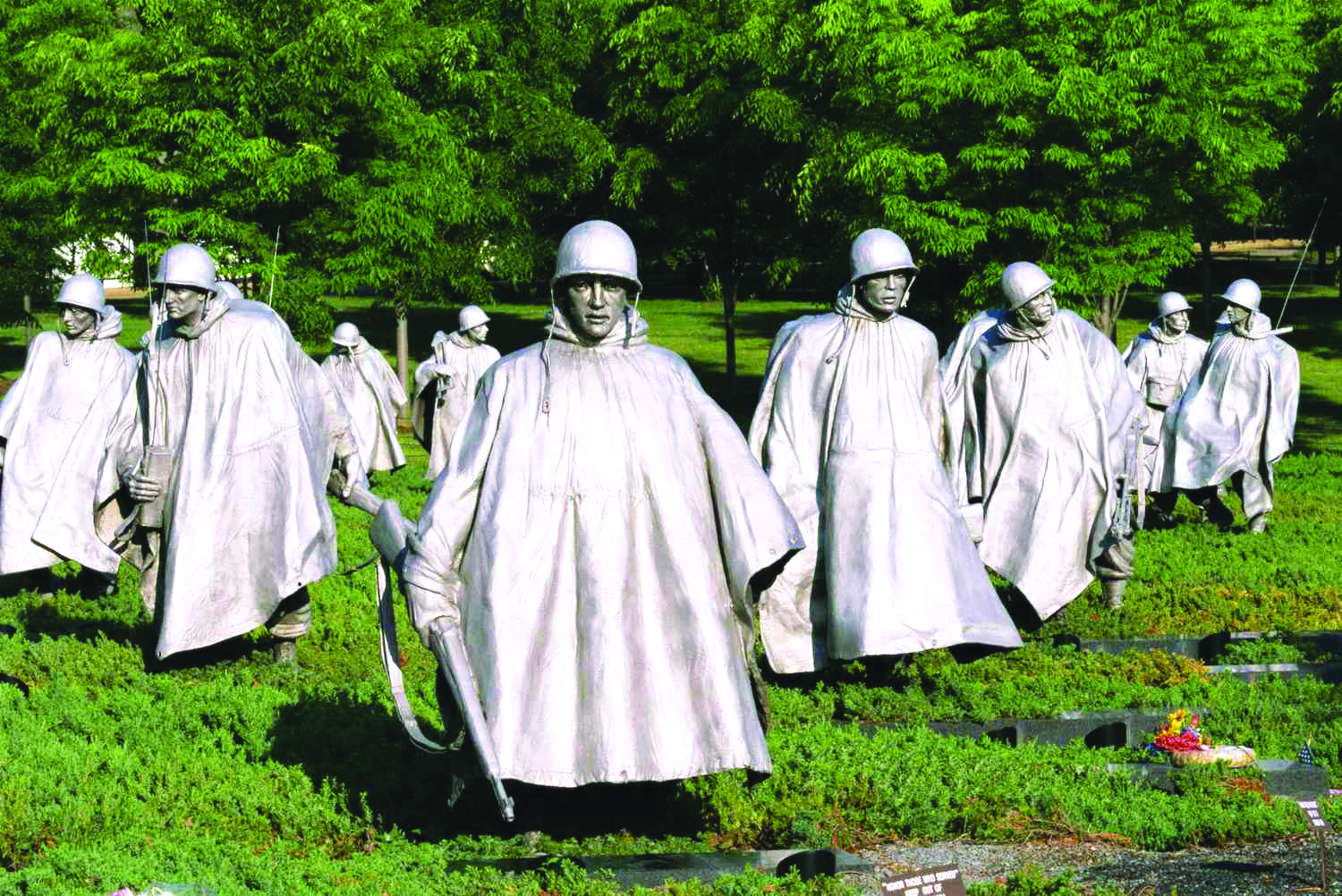
Today, July 27, 2023, is the 70th anniversary of Korean Armistice and is National Korean War Veterans Armistice Day. On July 27, 1953, North Korea and South Korea signed the Korean Armistice Agreement. Although the two countries are technically at war since no peace treaty was signed, the armistice brought about the end of the hostilities. I was there as a member of the Third Infantry Division, 9th Field Artillery Battalion when the fighting stopped.
Those of us who were there recall that early in June 1953, the tempo of action stepped up, and the 3d Infantry Division withstood heavy enemy attacks all along the front. The most bitter fighting took place on Outpost Harry on the Division’s left center, and against the Boomerang on the right flank. Despite determined enemy assaults, preceded and accompanied by heavy artillery and mortar barrages, the line held firm and the Chinese withdrew, defeated. During the intense Chinese attacks the 9th Field Artillery Battalion fired thousands of rounds in support of front-line infantry units inflicting great losses upon the enemy each time. The largest and fiercest battle since 1951 began on the morning of July 14, 1953, when over 60,000 Chinese Communist Forces (CCF) an estimated seven Chinese Divisions, launched a massive attack against the Republic of Korea (ROK) Capital Division, located in the Kumsong River valley between Sniper Ridge, on the west, and Christmas Hill, on the east. On July 15, the 9th Field Artillery Battalion moved into position near Kumsong; and it was four or five days later that members of Headquarters Battery began learning details about the attack. Much of what we heard was that two 105mm battalions, the 92nd Armored Field Artillery Battalion and the 555th (“Triple Nickel”) Field Artillery, had been hit hard.
Because the CCF offensive commenced on a cloudy day, it was shielded from aerial bombardment. A day later, the skies cleared and the air force started their attacks. But not before the 92nd and the 555th had been overwhelmed. Those battalions provided direct artillery support for the Capital Division. Shortly after the offensive began, the Capital broke and made a hasty and disorderly retreat. Some batteries of the 105mm units were not even notified that there was no infantry between them and the CCF. One battery received orders to bore sight and fire at point blank range. The crews looked up and saw CCF streaming down the mountain in front of them. A mortar round landed on the breech of one piece, disabling it and killing and wounding crew members. A CCF group had pulled a 90mm piece to a mountain top and were firing down on hapless gun pits. Only about 30 percent of the 92nd’s Charlie Battery got out safely by the end of the day. Even worse, the Triple Nickel was overrun, suffering 22 killed, 19 wounded, and 46 captured. The captured had to march northward for several weeks and were not freed for two or more months after the truce was signed.
After the 3d Division, including its artillery and tank units, was in position by the evening of July 15, it staunched the flow of CCF, who had penetrated several miles. The 65th Infantry Regiment stood firm despite thousands of enemy mortar and artillery rounds; the 15th Regiment inflicted heavy casualties. On July 18, the 64th Tank Battalion routed a mass of CCF gathering for battle. In its counterattack, the 3rd Division tried several times to cross the Kumsong river and hold its north bank; but it abandoned the effort after July 20, when the battle wound down. Though the fighting continued along the front until the final minute prior to the cease fire at 2200 hours on 27 July 1953, the Chinese advanced no further. The enemy drive in the Kumsong sector had been stopped.
When the conflict began, Americans were still rebuilding their lives in the aftermath of World War II, enjoying the blessings of peace and looking toward a future filled with hope and prosperity. When freedom and democracy were under threat on the Korean Peninsula, however, 2 million Americans left their homes, put on our Nation’s uniform, and answered their country’s call to duty. Their resolve was tried and tested in once obscure and unfamiliar places, such as Pork Chop Hill, Heartbreak Ridge, Chipyong-ni, Pusan, and the Chosin Reservoir, and in unnamed locations known only by grid coordinates or hilltop elevations. Alongside tens of thousands of coalition troops from our allies around the world, these individuals fought, bled, died, went missing, and suffered brutal captivity to defeat a determined foe amid the harshest of conditions, including sweltering heat, bone-numbing cold, and deep snow that buried valleys and rugged ridgelines. Their unquestioned valor, determination, and patriotism halted communist aggression and restored liberty and dignity for the South Korean people. In our Nation’s Capital, the black granite wall of the Korean War Veterans Memorial stands as a testament to their sacrifice, etched with the words “Freedom is Not Free.” In total, more than 36,000 Americans gave their lives in the Korean War, more than 103,000 were wounded, and nearly 8,000 went missing in action.
On July 27, 1953, the Armistice was signed and all fighting stopped.
Ron Hill is with the Blue Ridge Mountains Chapter of the Georgia Society, Sons of the American Revolution.