
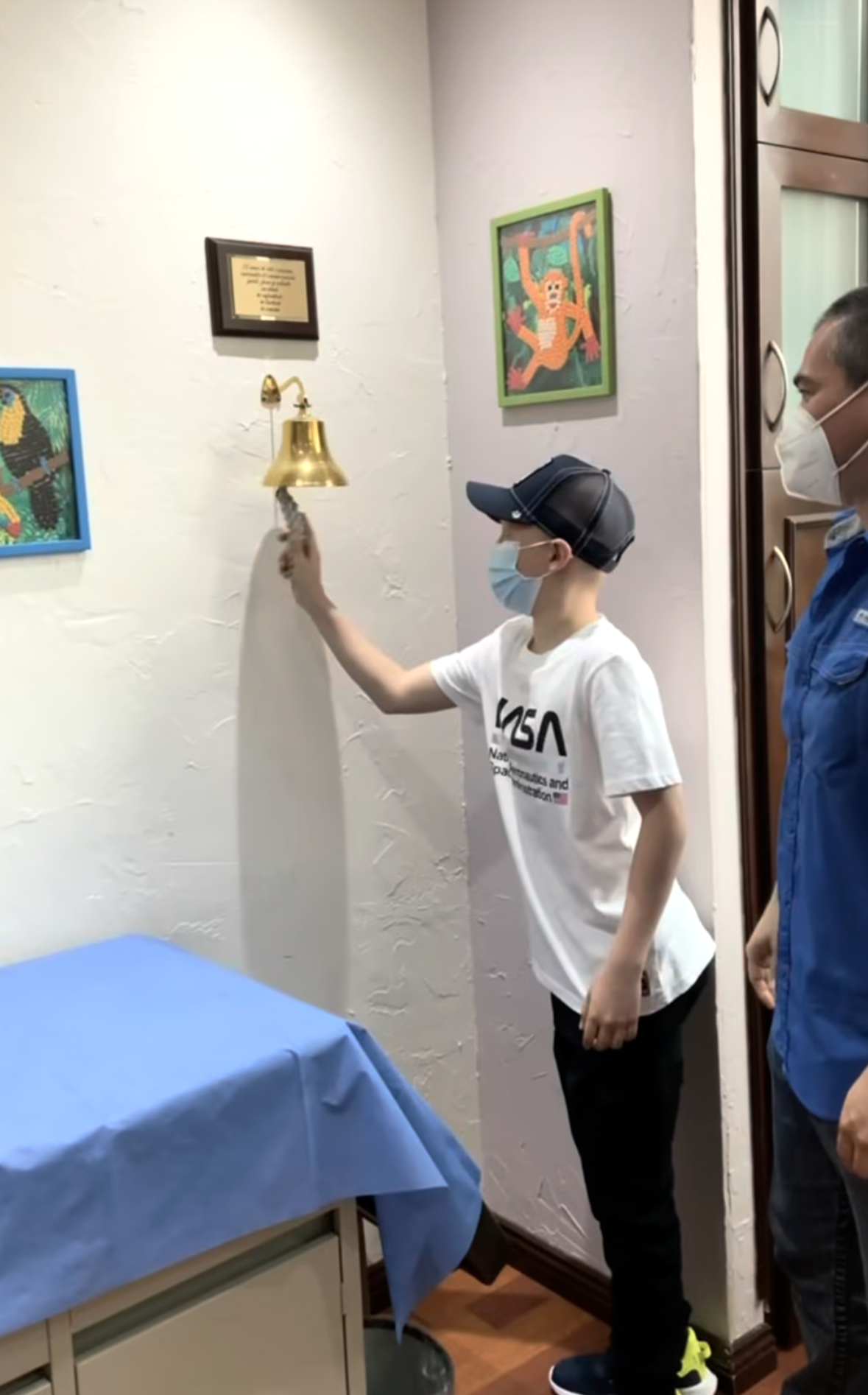
Submitted. Hector Nahle, pictured here at 12 years old, rings the bell after becoming cancer-free. Nahle was diagnosed with bone cancer as a child, but has persevered and continues to pursue his football dream.
Growing up as a child in Mexico, where soccer is king, Hector Nahle fell in love with American football.
One day his father, Hector Sr., was watching the Dallas Cowboys in the Nahles’ home in Torreón, Coahuila.
The younger Nahle, then 6 years old, was instantly captivated. At Nahle’s request, his father signed him up to play football when he turned 7.
Months before his first season, he and his father attended a Cowboys practice that summer, where Nahle said he first fell in love with football. After his first practice with his team back home, the feeling intensified.
“After my first practice, I knew like, I love this,” Nahle said. “I’ve played soccer before. I’ve done gymnastics before, but nothing felt like football.”
Nahle told his father – who played semi-professional soccer – that he wanted to play professional football. As a child, his father put in a plan to help him achieve that goal, taking Nahle to camps and private coaches in Texas and California, often using the family’s vacation money.
“There’s no Mexican that’s ever started in a football game, a NFL game. So it’s impossible as of right now,” Nahle said. “It’s impossible until somebody goes and does that. And it’s not gonna be easy. It made me dimension the size of the picture and what I wanted to do.”
During Nahle’s back-and-forth training between Mexico and the United States, the COVID-19 pandemic caused widespread lockdowns. He and his father saw it as an opportunity to work harder. They revised their plan for Nahle – 11 years old at the time – with two workouts a day and mobility sessions.
In May 2020, around Nahle’s 12th birthday, he started feeling discomfort in his right leg. Thinking that it was just a minor strain, he and his father continued to train.
But after a month, the pain remained. Different treatments followed, including acupuncture, but there was still no relief.
An MRI revealed that Nahle had a tumor in his right leg, but he was told there was a 95 percent chance it was benign. He stayed in the hospital for a week to have more tests as friends and his coach visited.
Later that week, on Sept. 1, 2020, the doctors informed Nahle’s parents the 12-year-old was diagnosed with bone cancer. Nahle’s only prior experience with cancer was when his grandfather died due to melanoma.
“My first thought was I was gonna die. I thought it was over,” Nahle said. “‘Why me? What did I do wrong to get this? I was such a healthy kid. I had huge dreams, and now I’m gonna die.”’
Nahle’s treatment option in his hometown was chemotherapy, and then amputating his leg, the doctor told him and his parents. Despite being told it was “either Hector’s leg or Hector’s life,” his mother, Luzmaria Herrera, refused to have Nahle’s leg amputated.
They sought a second opinion from a doctor in Monterrey, Mexico, over three hours from their home in Torreón, Coahuila.
The doctor in Monterrey offered a different treatment plan. Nahle would go through chemotherapy, but would have 10 centimeters of his fibula removed, rather than amputating his leg.
Nahle and his family switched doctors and drove three-and-a-half to four hours every other week for chemotherapy. The treatment took a toll on Nahle’s body.
He would frequently throw up, and after the first round of chemo, he couldn’t walk up the stairs at home. As he went through treatment, he lost his hair and his face became bloated. He no longer felt like himself.
But his mother was not going to allow him to have a victim mentality as he underwent treatment.
“I remember I was crying in the hospital and my mom comes up to me and shw’s like, ‘Alright, quit that,’” Nahle said. “‘The whole family’s with you. Look at what you have. You’re in one of the best hospitals in Mexico. You’re not gonna get your leg amputated, and you’re alive right now. Appreciate your reality .… What story are you going to write with this adversity you’re going through?’”
Nahle said he and his family began treating his situation like he was the main character of a movie, and his cancer battle was another chapter in that movie. He used that same mentality later down the road in football, too.
As treatment continued, hospital bills continued to pile up. After peeking at one of the hospital bills, Nahle began questioning how not only his family, but other families in Mexico could afford such treatment.
As he continued to battle cancer, Nahle and his parents began a nonprofit clothing brand, “Honor X Legacy,” to help others in Mexico battling bone cancer. With the help of social media, the nonprofit took off. As of 2026, they have helped four cases of bone cancer in Mexico.
After four initial rounds of chemo, Nahle had surgery in December 2020 to remove 10 centimeters of his fibula. Following the surgery, he had seven more rounds of chemotherapy.
After 11 rounds of chemotherapy and the surgery, Nahle was officially cancer-free in May 2021, five days before his 13th birthday.
As he rang the bell, he saw memories of his year-long battle with cancer flash before his eyes. He had visualized the moment time and time again during treatment.
“When I rang the bell in real life, I saw all the months come in one ring,” Nahle said. “When I shook that arm, I saw all the chemo, all the crying, my mom crying, my dad was crying there with me, the doctors were there. It was a very powerful and meaningful achievement for me and my family.”
But during his treatment, his dream never changed.
Nahle continued to workout and chase his football journey.
He eventually returned to the field in Mexico after beating cancer, before moving to the United States to begin his high school football career.
Nahle spent his freshman season at United High School in Laredo, Texas. He moved there by himself and lived with a family in the area.
After a year in Texas, Nahle began looking for other schools that would give him a better chance at college recruitment and higher levels of competition, along with a bigger platform. He reached out to several prep schools and received an opportunity from Rabun Gap-Nacoochee School and head football coach Derek White.
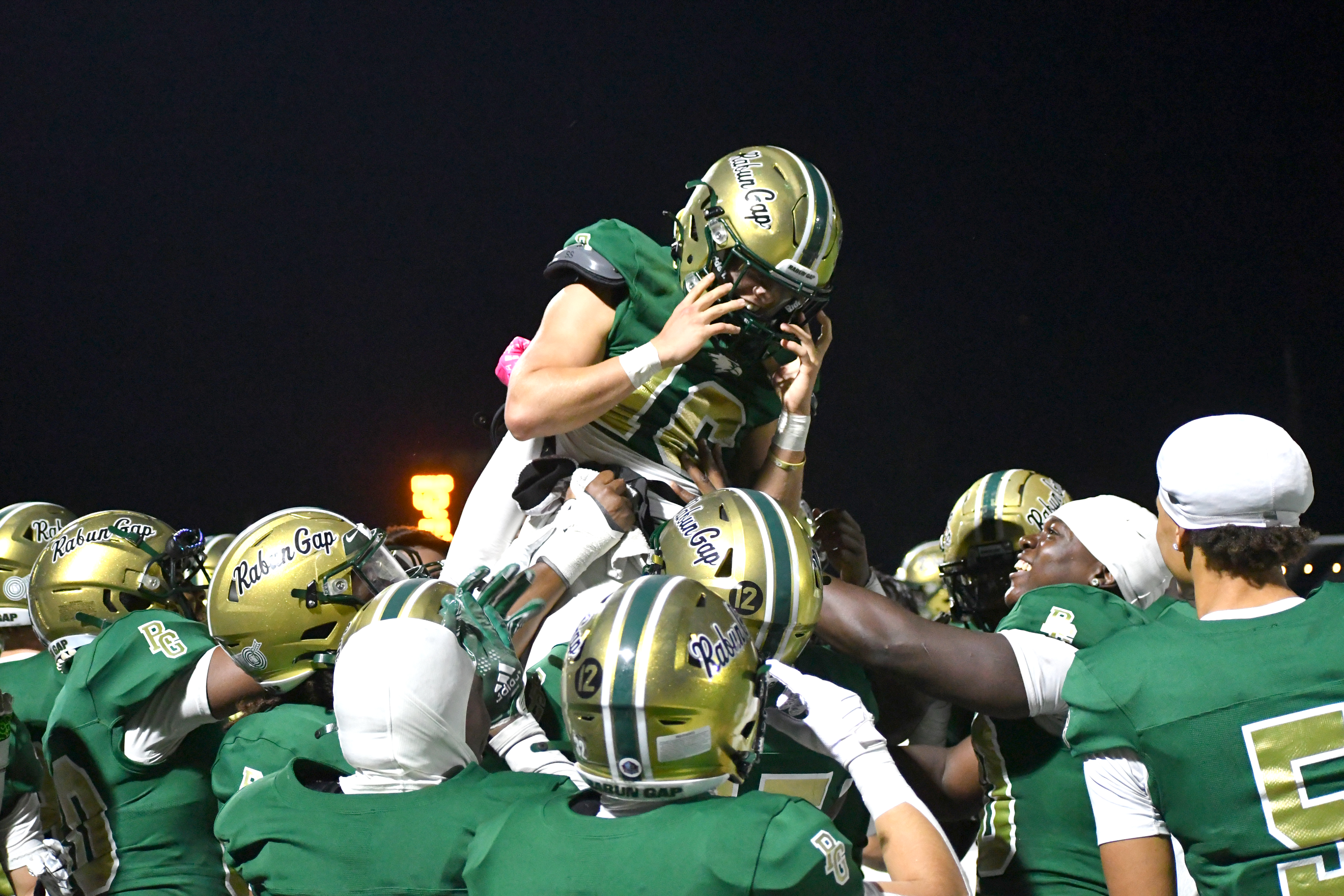
He moved to Rabun Gap in January 2024. In his first season at RGNS, he was one of the team’s backup quarterbacks as the Eagles went 11-2 and won the program’s first-ever state title.
In 2025, he was the third-string quarterback behind now-Memphis freshman Gavin Owens and Virginia commit Grayson Clary, but appeared in 11 of the team’s 12 games as RGNS made the semifinals for the sixth consecutive season.
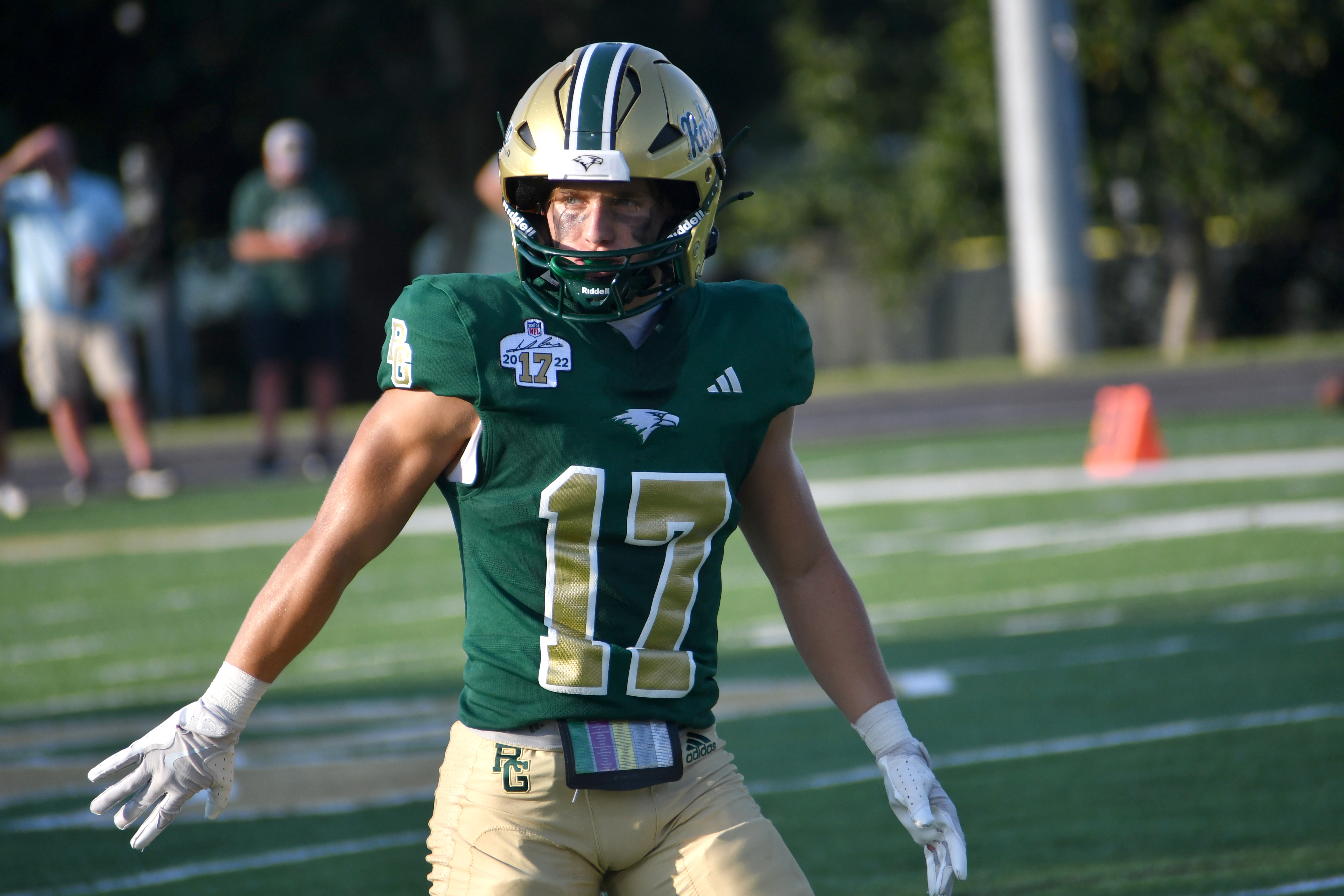
Ahead of his senior season, Nahle transitioned to wide receiver and has brought in six receptions for 78 yards – the fifth most on the team – this season. This summer, he earned his first collegiate offers from Waynesburg University, Shorter University and Erskine College.
“It brings a mentality. Most times when we do a breakdown, he’s the one in there motivating us,” said Rabun Gap running back and Nahle’s roommate Jordan Lindo. “It kind of gets the team going. I think the biggest piece is he’s a good motivator, and just the person that he is, after what he’s been through, pushes everyone else to be better.”
He also now wears the No. 17, which dons a patch worn by former RGNS tight end Marlin Klein, who was recently drafted by the Houston Texans.
Klein, who came to Rabun Gap from Germany, is the program’s first NFL alumnus.
Nahle was chosen by the coaching staff before this season to wear the jersey, which features the first of what will likely be several future patches honoring NFL alumni. The patch symbolizes a journey, but is also a reminder of the dream that began as a child in Mexico.
“When you meet Hector, that’s not what he wants you to know about him,” Rabun Gap linebacker and Nahle’s roommate Jay Schell said of Nahle’s story. “You introduce yourself to him, and he’s a football player from Mexico who’s trying to go D-I. He doesn’t tell you about the cancer and all that. He doesn’t want to be a victim.”
As Schell said, Nahle does not want to be a victim.
And his battle with cancer is not what he wants to be remembered for. He simply wants to be remembered as Hector, and whatever that looks like to others.
“I just want to be remembered as Hector. And whatever that comes with in that situation,” Nahle said. “Because I know everybody has a different perspective of me. That’s always gonna change, but I’m always gonna try to be myself and have my own spark shared across the world."